Japan CV format at a glance
| Document name | Rirekisho & Shokumu Keirekisho |
|---|---|
| Typical length | Rirekisho 1–2 pages plus a 1–2 page work-history document |
| Photo | Yes on the rirekisho |
| Date of birth | Yes on the rirekisho |
| Marital status | Optional |
| Spelling and language | Japanese for Japanese employers; English for foreign-owned companies |
| Paper size | A4 / B5 |
These are common conventions, not laws. Some employers and industries differ, so follow the instructions in each job advert.
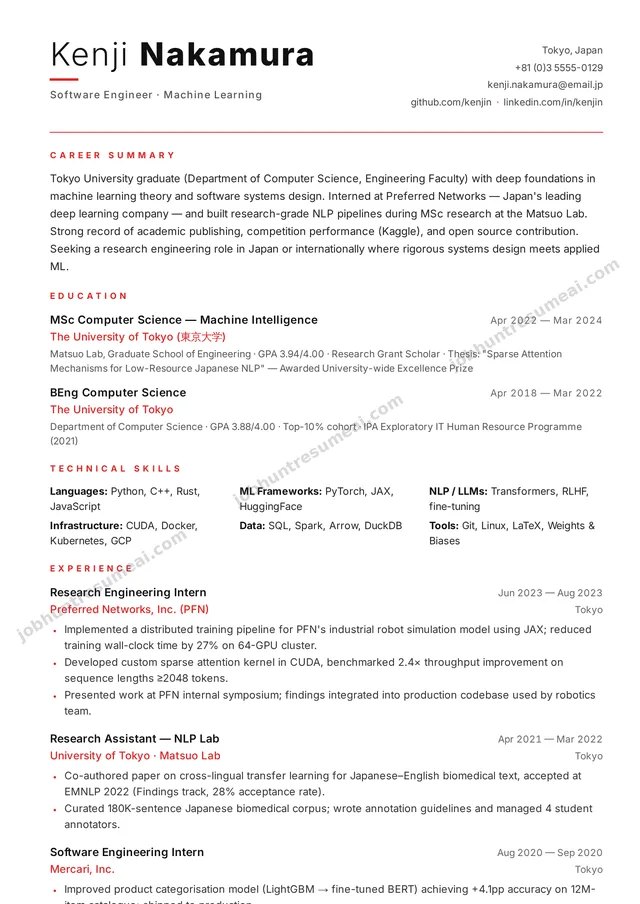
What to know before you write
- Japanese employers often ask for two documents: the rirekisho (a standard personal-history form with a photo) and the shokumu keirekisho (a detailed work-history document).
- The rirekisho follows a set template with fields for name, date of birth, address, education, work history and qualifications.
- Write in Japanese if the employer is Japanese. Foreign-owned companies and English-language roles often accept an English resume.
- Dates are usually written by year and month; some forms use the Japanese era system.
- Use a recent, formal photo on the rirekisho when the form asks for it.
- If your Japanese is limited, state your JLPT level honestly.
Recommended section order
- Rirekisho: personal details, photo, education, work history, qualifications, motivation
- Shokumu keirekisho: employers, roles, responsibilities, results
- Qualifications and licences
- Language ability (JLPT or equivalent)
- Self-promotion (jiko PR)
Use plain section headings, a single-column layout and standard fonts so that applicant tracking systems (ATS) read your document correctly. Export to PDF with selectable text.
Common mistakes to avoid
- Sending an English resume to a Japanese-language job posting.
- Leaving fields blank on the rirekisho.
- Claiming a JLPT level you have not passed.
- Missing dates for education or employment.
- Using a casual photo.
Frequently asked questions
What is a rirekisho?
A rirekisho is a standard Japanese personal-history form, usually with a photo, covering education, work history and qualifications.
What is a shokumu keirekisho?
It is a detailed work-history document that describes roles, responsibilities and results.
Can I apply to Japan with an English resume?
Foreign-owned companies and English-language roles often accept English resumes. Japanese employers usually expect Japanese documents.
Is a photo needed?
The rirekisho typically includes one.
Should I list JLPT level?
Yes, if you have a certificate. Do not overstate it.
Can I build a Japan CV online with JobHunt Resume AI?
Yes. Choose Japan in the builder and enter your real details. It applies Japan formatting conventions and creates an ATS-friendly resume and cover letter that you can download as a PDF. Paid plans start at $9.
Build a Japan CV from your real details
JobHunt Resume AI formats your own information to Japan conventions and scores it for ATS readability. It never invents jobs or numbers for you. Plans from $9 with no auto-renewal.